Thursday, June 25, 2009

Here’s a Clue: Mr. Kumar, With a Gun, in India


“Q&A,” the novel that became the basis for the smash-hit film “Slumdog Millionaire,” used questions from a television quiz show to prompt flashbacks about its main character’s life story. Here’s a question for its author, Vikas Swarup: Can a novel be any more high-concept than that?

Yes it can. Mr. Swarup’s second novel, “Six Suspects,” is a Bollywood version of the board game Clue with a strain of screwball comedy thrown in. Its stock characters are easily identified: the Bureaucrat, the Actress, the Tribal, the Thief, the Politician and the American. Each attended the party at which a man named Vicky Rai, a playboy film producer, was murdered. Each has a gun and a motive. And although the story’s geographical span is even bigger than India, the whole thing feels handily confined to the kind of isolated, air-tight setting that Agatha Christie’s readers love.

Thanks to such a schematic setup “Six Suspects” is gleeful, sneaky fun. But it’s also a much more freewheeling book than the format implies. Mr. Swarup, an Indian diplomat, brings a worldly range of attributes to his potentially simple story. And he winds up delivering a rambling critique of Indian culture, taking shots at everything from racism to reality TV. Yet Mr. Swarup’s style stays light and playful, preferring to err on the side of broad high jinks rather than high seriousness. A fizzy romp seems to be the main thing he has in mind.

- Janet Maslin, New York Times

Read the rest of the review here.

Read an excerpt from 'Six Suspects' here.

Wednesday, June 24, 2009

Top 10 literary ménages à trois


Ewan Morrison is the author of three novels which explore modern relationships and sexuality: Ménage, Distance and Swung. Ménage, his most recent novel, is the story of three bohemians in a ménage à trois in 90s London.

"The ménage à trois is a rich and rarified fictional seam which arose in the 19th century and originated from memoirs or fictionalised accounts of real-life events. The number of ménages à trois (as yet barely documented) which occurred in the lives of artists, writers and leaders from the 19th century to the present day – from DH Lawrence and George Bernard Shaw to Pablo Picasso and Jack Kerouac – is intriguing, and begs the question: was the ménage à trois the ideal (if publicly unacceptable) lifestyle of the modern 'radical'?"

1. Garden of Eden by Ernest Hemingway

The erotic novel that Hemingway suppressed during his own lifetime, and left incomplete on his death, is set in the Cote d'Azur in the 1920s and tells the story of an author, his adventurous wife, and the psycho-sexual games they play while sharing a young woman. It is largely held to be autobiographical.

2. Jules et Jim by Henri Pierre Roche

Adapted for film, starring Jeanne Moreau, by Francois Truffaut in 1961, the original novel was based on Roche's own experiences with a German couple, the Hessels, between the wars. Roche's seven-volume diary of his many loves and love triangles, which include those with noted surrealists and dadaists, remains unpublished to this day.

3. Politics by Adam Thirlwell

An eccentric, contemporary, urbane ménage à trois with a half-Jewish male, a daddy's girl and a bisexual Indian actress. Meditations on the sex life of Adolf Hitler and Chairman Mao are intercut with descriptions of London and extreme sexual acts in this multicultural mélange that screws around with form as much as it does with character and race.

- Ewan Morrison, Guardian.co.uk

Read the rest of the article here.

Tuesday, June 23, 2009

Can South Africa's literary community turn a new page?


The country's once-struggling book industry is now booming, but more needs to be done to encourage reading amongst the entire population.

Last month I visited my brother in Cape Town. He put together the most amazing itinerary: the "big five" in Kruger National Park; lounging on the beach and watching the cold surf in Kleinmond; seafood on the seashore in Hermanus; wine and escargots in Franschhoek for the price of burgers and coke back home; flowers and weddings in the Company Gardens, and hiking up Lion's Head.

But what I was by far the most grateful for was the tireless manner in which he drove me to every bookstore I could find, and his patience as I browsed through miles of new and used books. After which, I can happily report that Cape Town and its environs is home not only to the world's most fecund floral kingdom, but also a thriving literary life.

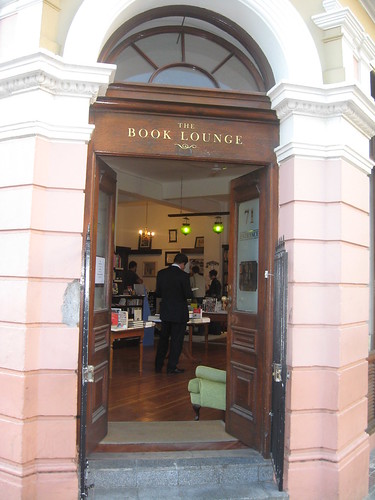
Almost everyone I met spoke of Cape Town's growing literary community; of how the industry had turned itself around after years of neglect by the chains, independent bookstores such as The Book Lounge and Kalk Bay Books were now. As the Lounge's Mervyn Sloman put it, they were: "filling the void, treating customers with respect, hiring people passionate about the profession, and caring about more than just stock turnover".

- Nigel Beale, Guardian.co.uk

Read the rest of the article here.

Friday, June 19, 2009

I'm Only Being Honest


The joy I get from helping little people stand taller is unbounded. That's why I insist midgets have boxes to stand on.

Contra-BLOODY-ception. Why don't kids bother? I never wore a condom when I was young, but then no one ever wanted to shag me.

- excerpts from The Digested Read of Jeremy Kyle's 'I'm Only Being Honest' by Jim Crace, Guardian.co.uk

Read the whole digested read here.

Thursday, June 18, 2009

The Sky Is Falling Soon! (And Junior Is Agitated)


As Ron Currie Jr.’s new book begins, an omniscient voice gives instruction to a baby boy still in utero. “First, enjoy this time!” the voice says. “Never again will you bear so little responsibility for your own survival.”

The voice goes on to outline what the unborn child can expect from life. The child will learn to walk. After that, it’s told, “you must learn to run, share, swing a bat and hold a pencil, love, weep, read, tie your shoelaces, bathe and die.” Die? Already? How? The voice helpfully proclaims that 36 years and 168 days after the child is born a runaway comet will smash violently into planet Earth.What these opening passages also announce is that Mr. Currie is a startlingly talented writer whose book will pay no heed to ordinary narrative conventions. His thoughts on cosmic doom somehow take the form of a joyride. He survives the inevitable, apt comparisons to Kurt Vonnegut and writes in a tenderly mordant voice of his own.

- Janet Maslin, New York Times

Read the rest of the review here.

Read an excerpt of 'Everything Matters!' here.


Wednesday, June 17, 2009

Three books about surfing


The imagery of surfing is everywhere. In Las Vegas casinos, posters of bronzed surfers tucking into turquoise tubes are as prevalent as those of diamond-bedecked women and fast cars. The message - that surfing offers a slice of paradise - is unambiguous. It has been enthusiastically co-opted by any number of mainstream brands, including Pepsi, which produced an advert in which David Beckham was cast as a surf dude, and American Express, which produced a series of commercials in which the Hawaiian big-wave surfing legend Laird Hamilton was as much a star as were the likes of Robert De Niro and Martin Scorsese.
- Alex Wade, Times Online

Read the rest of the article here.

Friday, June 12, 2009

The Girls of Summer


While we're freezing in our South African winter, The New York Times discusses their Summer reads for the fairer sex.

The “Commencement” characters are savvy about, among other things, feminism and publishing. “When a woman writes a book that has anything to do with feelings or relationships, it’s either called chick lit or women’s fiction, right?” one of them asks. “But look at Updike, or Irving. Imagine if they’d been women. Just imagine. Someone would have slapped a pink cover onto ‘Rabbit at Rest,’ and poof, there goes the ... Pulitzer.”

They’re right of course. But this is the season when prettily designed books flood the market and compete for female readers. It’s a time when literary and lightweight books aimed at women become hard to tell apart. Their covers use standard imagery: sand, flowers, cake, feet, houses, pastel colors, the occasional Adirondack chair. Their titles (“Summer House,” “Dune Road,” “The Wedding Girl,” “Trouble”) skew generic. And they tend to be blurbed exclusively by women.

- Janet Maslin, New York Times.

Read the rest of the reviews here.